
Two different beasts: Airline consolidations in the EU and the US || Insight
As European airline majors call for more consolidation, comparisons with the US American, notoriously consolidated market, should be made carefully.

The consolidation of European airline industry is both a fact and a common rallying cause. During the Airlines for Europe (A4E) summit in Brussels earlier this year, the heads of Lufthansa Group, Air France-KLM, and IAG (the parent of British Airways and Iberia, among others), have all called for more consolidation “to preserve European competitiveness”.
Luis Gallego, IAG’s chief executive officer, recently criticised the EU for making mergers and acquisitions difficult when asked about his interest in buying easyJet. IAG tried to buy Spain’s Air Europa, but was effectively blocked by the European Commission.
A lot of pro-consolidation arguments build on comparisons with the US, where much larger airlines are more profitable and efficient.
(Whether consolidation is good for passengers or not is a different question, and answer vary: merged airlines are generally more efficient, and some researchers argue they improve market outcomes in terms of accessible fares and routes, at least in some cases. Others point out that the merger process itself can be very disruptive, and many have argued they actually hurt passengers and lead to higher fares. This is all background reading - this article is not about this question.)
At the recent IATA AGM in Rio de Janeiro, I somewhat accidentally touched upon the subject with two executives of some of the world’s largest airlines, Southwest from the US (read the full interview here), and the other from the EU. Both pointed out that the regulatory differences mean that one cannot simply compare consolidation in the two jurisdictions — while data shows that the EU is not as fragmented as it might seem at the first glance.
I'm always joking with my counterpart at United that his life is much different than my life, but he also says my life is different from his life. They have one brand, they have still a multi-hub setup, but it's a different setup. This will never exist in Europe because, I think, in Europe we live the heterogeneity, the brands, the engagement of our customers with the different brands. (A C-Level executive at one of the largest EU airlines)
Is Europe consolidated?
There is no doubt airline consolidation is in full swing in the EU.
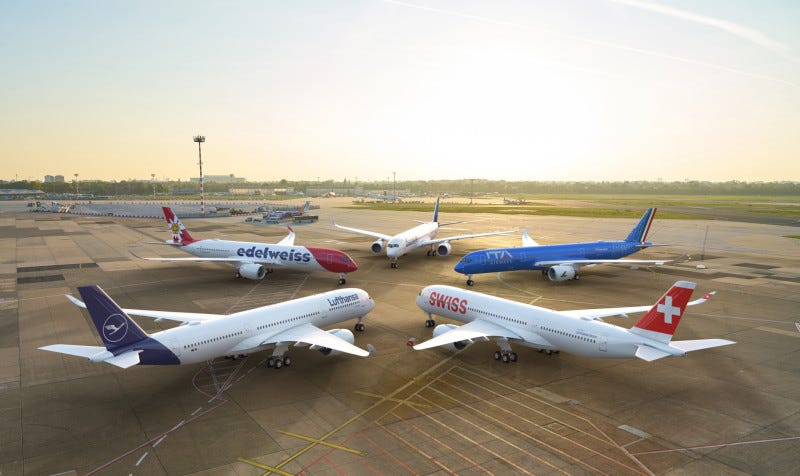
After the recent acquisitions of SAS Scandinavian Airlines by Air France-KLM, and ITA Airways by Lufthansa Group, and the likely sale of TAP Air Portugal to one of those holdings, there are just a few independent hub-and-spoke carriers remaining on the continent: LOT Polish Airlines, Finnair, Air Serbia, and technically Air Europa, although it has both British Airways’ parent IAG and Turkish Airlines among its shareholders. Some smaller airlines, such as Romania’s TAROM, are looking for buyers.
Nonetheless, on face value, the US airlines are still far more consolidated than their EU counterparts after a decades-long string of mergers and acquisitions.
The four largest US airlines (American Airlines, Southwest Airlines, Delta Air Lines, United Airlines) control an 80.3% market share in terms of scheduled domestic capacity. Their fleet sizes trump any individual EU carrier - indeed, even Alaska Airlines and JetBlue Airways, much smaller airlines by US standards, have more aircraft than nearly all EU airlines except Ryanair.
This is despite the EU actually being a bigger “domestic” market (not legally domestic, but in many aspects it should be treated as such). In 2025, there were around 850 million passengers travelling domestically within the US, compared to around 1.1 billion in the EU.
But if we look at airline groups rather than individual AOCs, the US dominance is no longer that huge. The four largest carriers retain their spots, but the four dominant EU-based holdings are now much larger and completely overrun the US’s “also-rans”, Alaska and JetBlue.
This distinction between an airline-level fleet and a group-level fleet points to the core difference between airline consolidation in the US and the EU. In the former, consolidation is simply a corporate process of acquisitions and getting bigger. In the latter, it’s a semi-political debate which necessitates careful branding, base, and network decisions that is often more of a combination of semi-separate entities than a full-on merger. And that’s probably why the EU will never reach the same level of airline consolidation as the US (and arguably, for the better).
What does it mean (for operations)
The debate over whether consolidation is, in general, a good thing in terms of fares, network, and service quality is complex and widespread. But what do the differences between US and EU consolidation mean for operations and business models?
Hub protection. Consolidation in Europe nearly always includes formal protections for a hub. Do you want to buy ITA Airways? Fine, but Rome has to remain a hub. US airlines retain a multi-hub setup after taking over other carriers, but the structure is less rigid, and driven by network considerations and labour agreements rather than formal guarantees. This also means that US airlines tend to look for merger opportunities to add aircraft and market share, whereas in the EU, transactions are at least partially driven by network opportunities with a new hub.
Brands remain. For similar reasons, EU mergers rarely lead to the disappearance of a brand. Because airlines are either state-owned or at least historically linked to national companies, there is a far stronger political and social connection with the brand. While the disappearance of Northwest Airlines after the merger with Delta Air Lines, or of Continental after the merger with United were big events on the US market, they both happened without too much protest. In contrast, the liquidation of KLM in the Netherlands after merger with Air France, or Austrian Airlines after the takeover by Lufthansa, is unthinkable.
Multiple air operator’s certificates (AOCs). The preservation of brands and hubs, by extension, leads to the retention of multiple certificates within the holding. There is a traffic rights argument to this (with non-EU flights, it still sometimes matter whether a company has an Austrian or German AOC), but there is also a level of complexity unavoidable due to the politics of the mergers. This makes EU airline groups inherently less efficient, but also indirectly protects their customers on smaller markets - closing a local airline, with the local staff, offices, and aircraft, is just as difficult as closing their hub.
More decentralised operations for LCCs. However, Andrew Watterson, the chief operating officer from Southwest, pointed out that the flip side of the EU regulatory environment was that for low-cost carriers, it actually encourages base diversification. That’s why Southwest Airlines has just 13 bases, and Ryanair — across its five AOCs — 96 in total.
It would be a cost increase for US carriers to mimic what Ryanair does. It would raise our costs. The reason European LCCs can do that is because they can have an arbitrage between labour laws between different countries, which allows them to have much smaller bases. In the US, it would be terribly inefficient to have so few pilots and flight attendants per base. (Andrew Watterson, COO Southwest Airlines)